

Oil that comes straight off a screw or hydraulic press is not clear finished oil. It carries suspended solids - cake fines, seed hull fragments, meal particles and oil foots - that give it a cloudy, dark look and settle into a sludge at the bottom of the tank. These solids do not improve the oil's keeping quality or taste, and they can clog pumps, heat exchangers and downstream equipment if left in. Filtration after extraction is the step that separates this mechanical residue from the oil.
Which method a plant uses depends on how clean the product must be, how much oil it produces, and whether the oil is sold as pressed crude or sent on to refining. A small press operation selling filtered pressed oil has different needs than a large mill feeding a refinery. Understanding the common methods, and what each does best, makes the choice easier.
Settling and Decanting
The simplest method is settling: let the hot crude oil stand in a tank so heavier particles sink to the bottom by gravity, then draw the clear oil off the top. It needs no machinery beyond a tank, and it removes the coarser cake debris before any fine filtration. Settling works well as a first stage, especially in small operations.
Its limits are real. Settling is slow, needs tank space, and leaves fine particles and colloidal matter that are too light to sink quickly. Oil viscosity slows the fall, which is why warm oil settles faster than cold. In practice settling is usually combined with a filtration or centrifugal step rather than relied on alone, and the sludge drawn off the bottom still contains recoverable oil that can be handled separately.
Bag and Cartridge Filtration
Bag filters and cartridge filters pass the oil through a woven bag or a pleated cartridge that traps solids on the medium. They are compact, simple to operate and easy to maintain - the bag or cartridge is replaced or cleaned when it loads up. Bag filters suit coarse and medium clarification as a first stage; finer cartridges give a clearer, polished oil for retail packaging.
These filters work best on oil that has already had its bulk solids removed, because a bag that fills with coarse cake fines quickly loses flow and needs frequent changing. They are a common polishing stage at the end of a line, and their mesh or micron rating is chosen to match the clarity required. They do not handle a heavy, sludge-laden crude oil on their own.
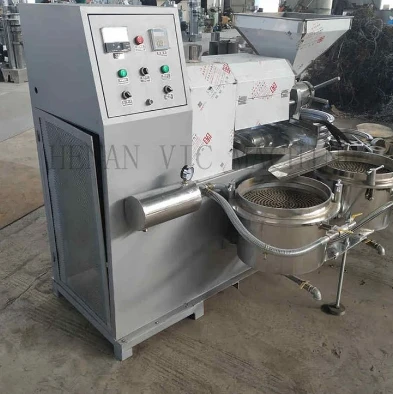
Plate-and-Frame and Leaf Filters
The plate-and-frame filter press is the workhorse for batch pressed oil. Oil is pumped under pressure between plates covered with filter cloth or paper, and solids build into a filter cake on the cloth while clear oil passes through. It removes a large share of the foots and fines, produces a clean oil, and the spent cake can be discharged when the plates are opened. It suits small and medium batches where strong clarity is wanted, though it runs in cycles rather than continuously.
Pressure leaf filters work on the same pressure-filtration principle but use filter leaves inside a closed vessel, and are common in larger mills for direct crude-oil filtration. They handle higher flow and can be cleaned and discharged more continuously than a press. Both methods rely on a filter cloth or mesh medium and on enough pressure to push warm oil through; the filter cake itself often helps trap the finer particles in later cycles.
Centrifugal Separation
Centrifuges spin the crude oil at high speed, using centrifugal force to throw the heavier solids out to the wall far faster than gravity could. Decanter or disc-type centrifuges handle continuous, high-volume streams well and remove fine suspended particles that settle slowly or stay partly suspended. They are valued where continuous production and high throughput matter, and where the oil is too loaded with fine solids for bag filters alone.
Centrifugation separates solids by density, so it works best on particles with enough density difference from the oil; very fine, colloidal or gummy material may still need a polishing filter after. A centrifuge is a higher-investment, maintained piece of equipment than a filter bag, but in a large mill it replaces slow settling and frequent filter changes with a continuous mechanical separation.
Choosing a Filtration Route
Most commercial lines do not use one method alone - they combine them by stage. Settling or a coarse bag removes bulk debris first; a plate-and-frame, leaf filter or centrifuge carries out the main clarification; and a fine bag or cartridge polishes the oil before packing. The right sequence follows how dirty the crude oil is and how clear the final product must be.
Several practical points guide the choice. Oil filters more readily when warm, because lower viscosity lets it flow through the medium; over-cooled oil clogs filters and drops throughput. The mesh or rating must match the particle size you need to remove, and maintenance access for changing cloths, bags and cartridges matters as much as the filter itself. For a small pressed-oil operation, settling plus a bag or plate press is often enough; a larger mill sends crude through a centrifuge and polishing filters on the way to refining.
Conclusion
After mechanical extraction, crude oil carries cake fines, hull fragments and foots that have to be filtered out before the oil is presentable or ready for downstream refining. Settling removes coarse debris by gravity as a simple first step; bag and cartridge filters clarify and polish through a porous medium; plate-and-frame and leaf filters press oil under pressure for strong batch or continuous clarity; and centrifuges spin out fine solids in high-volume, continuous service.
The practical solution is usually a staged combination rather than a single machine: coarse removal, main clarification, then polishing, with oil kept warm enough to filter freely. Matching the filtration method to your throughput, your solids load and the clarity your market expects turns cloudy pressed crude into clean, marketable oil - and protects the pumps, exchangers and packaging equipment downstream.


