

When buyers ask about the capacity of an oil extraction machine, they usually mean how many kilograms of seed the machine can process in an hour or a day. The number on a quotation is only a rated figure, measured on a specific seed under controlled conditions. In a real mill, the throughput you actually get depends on the whole line around the press - the seed, its preparation, the way the machine is operated and how well it is maintained.
Two machines of the same screw size can deliver very different daily output in two different workshops. One shop runs dry, well-cooked, evenly fed seed and reaches steady throughput; the other feeds damp, variable material by hand and stops every few minutes to clear a blockage.
Understanding the factors below is what closes that gap.
Seed Type and Oil Content
The seed itself sets the starting point. Groundnuts, sesame and sunflower seed are rich in oil and press freely, so a screw expeller can move them through the chamber relatively quickly. Soybean is much lower in oil and harder to extract mechanically, so the same machine will process it differently and often leaves more oil in the cake unless a pre-press and solvent route follows.
Seed size, shell content and hardness matter too. Shells and hulls absorb volume without contributing oil, slow the press and create abrasion, which is why decorticating or dehulling high-hull seeds usually raises both throughput and oil recovery. Dirty seed with stones, dust and plant residue also wears the chamber faster and forces conservative settings. Clean, plump, high-oil seed is simply the fastest way to reach a machine's rated capacity.
Moisture and Temperature Conditioning
Moisture is arguably the single most sensitive variable in mechanical pressing. Seed that is too wet releases oil slowly, produces soft wet cake, clogs the drainage bars and leaves excess oil trapped in the cake. Seed that is too dry becomes powdery, the meal fails to form a proper plug in the chamber, and oil escapes with the cake instead of draining out. Each seed has a narrow moisture window in which the meal flows, compresses and releases oil cleanly.
Heat works together with moisture. Cooking or conditioning the flaked seed before pressing ruptures oil cells, lowers the viscosity of the oil so it flows more easily and adjusts the meal to the right plasticity. Hot pressing with properly cooked seed generally gives higher throughput and better oil release than cold pressing raw seed; cold pressing runs gentler and preserves oil quality but at lower output and higher residual oil in the cake. Conditioning equipment is therefore not optional for a mill that wants stable, nameplate-level capacity.
Pretreatment Before the Press
The press is only one stage in a chain. Before seed reaches the screw, a commercial line typically cleans it, removes hulls where needed, cracks or grinds it, rolls it into flakes and then cooks or conditions it. Each step prepares the cellular structure so that oil can be released quickly inside the chamber. Whole, unflaked hard seeds resist compression and force the press to work harder for every drop.
Grinding and flaking also make the feed more uniform, which matters for continuous operation. Extrusion or expanded preparation can go further by precooking and partially drying the material, giving the expeller a consistent feed that presses faster and more evenly. A bottleneck in cleaning, flaking or cooking will throttle even an oversized press, so the entire pretreatment line must be balanced to match the expeller rather than treated as an afterthought.
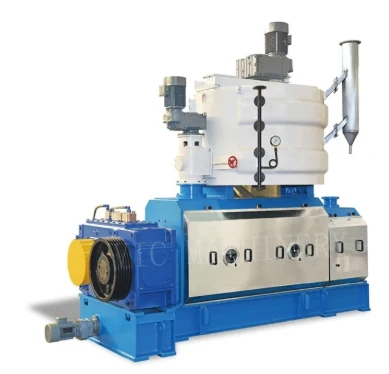
Screw Size, Chamber and Power
The machine itself has a physical capacity ceiling set by the screw diameter, the length and geometry of the pressing chamber, the main motor and the gearbox. A larger screw with a longer chamber carries more material and applies pressure over a longer zone, which is why larger models are rated for higher throughput. Heavy-duty gearboxes and adequately sized motors sustain torque under the heavy friction of continuous pressing; an undersized drive will stall or overheat when pushed.
The configuration of the screw and the cage bars also matters. Worm spacing, pressure profile and bar spacing are chosen for the seed, and some machines are set up for single pressing while others act as pre-presses ahead of solvent extraction. A chamber built for one seed or duty may not deliver the same throughput on another, so the machine should be specified around the crop and the process rather than a generic maximum number.
Feed, Speed, Pressure and Wear
How the machine is run decides daily output more often than its hardware does. A steady, even feed keeps the chamber full and the pressure profile stable, while hand-feeding in bursts causes surges, slips and downtime. The screw speed is a trade-off: higher speed pushes more material through but can shorten the pressing time and leave more oil in the cake, while lower speed extracts more thoroughly at reduced throughput. Mills tune speed to the seed, moisture and the residual oil they target.
The cake outlet and choke setting control back-pressure and cake thickness; a proper setting holds the meal in the chamber just long enough to release oil without choking the machine. Finally, the screw worms, pressure rings and cage bars are wear parts - as they wear, gaps open, pressure falls, and both throughput and oil recovery drift downward. Regular inspection, timely replacement of worn parts and consistent lubrication protect the rated capacity over the machine's life.
Conclusion
The capacity of an oil extraction machine is not fixed by its nameplate alone. The seed and its oil content set the ceiling, moisture and heat conditioning decide how freely the oil releases, and the pretreatment chain determines how well prepared the material arrives at the screw. Screw size, chamber design and motor power provide the physical limit, while feed consistency, screw speed, pressure settings and wear maintenance determine how much of that limit you reach day to day.


